
In Narok South, Kenya, the journey to a safe pregnancy is often impacted by vast distances and limited access to diagnostic services.
Only 31% of women in the sub-county attend four antenatal care (ANC) visits, far below Kenya’s average. Many pregnant women seek critical care late, making early detection of complications difficult. This can have serious consequences. For years, the Olmekenyu Dispensary in Narok was no exception. A partnership between Child.org and Hatch Technologies is changing this using point-of-care ultrasounds.
Before point-of-care ultrasounds: A system struggling to detect risk
As Facility in Charge at Olmekenyu clinic, Anne saw first hand how women slipped through the cracks of the health system:
- Olmekenyu had no ultrasound machine.
- The nearest facility with ultrasound services was 50 km away.
- Narok has few trained sonographers serving vast catchment areas.
- Out of 20 referrals Anne made for ultrasounds each month, only one woman completed the scan.
- Many mothers walked 10 to 30 km for ANC, only to be referred even further for services.
This combination of long distances and few specialists amplified delay three in maternal health: the delay in receiving adequate care even after a woman reaches a facility.
A turning point: Training healthcare workers on point-of-care ultrasounds
Child.org, in partnership with Hatch Technologies, donated portable Point-of-Care Ultrasounds (POCUS) to two high-need facilities, including Olmekenyu. This marked the beginning of a new chapter for frontline maternal care in Narok South. The donation was immediately followed by hands-on training for health workers from both facilities: a practical, skills-focused session designed to ensure that the technology would not sit unused, but become part of the daily rhythm of care.
For Anne,the moment was transformative. For the first time, she saw a diagnostic solution built for the realities she faces every day; long distances, staff shortages, unpredictable referrals and women seeking care late in their pregnancy. She finally saw a solution tailored to the realities of rural facilities.
POCUS solves three critical barriers at once:
- It is portable – ideal for remote and outreach settings.
- It can be operated by a trained health worker, not just a sonographer.
- It allows for immediate early detection of pregnancy complications, making referral for further diagnosis easier if needed.
Anne embraced the training with determination, not just to upskill, but to change the story for the women she serves.
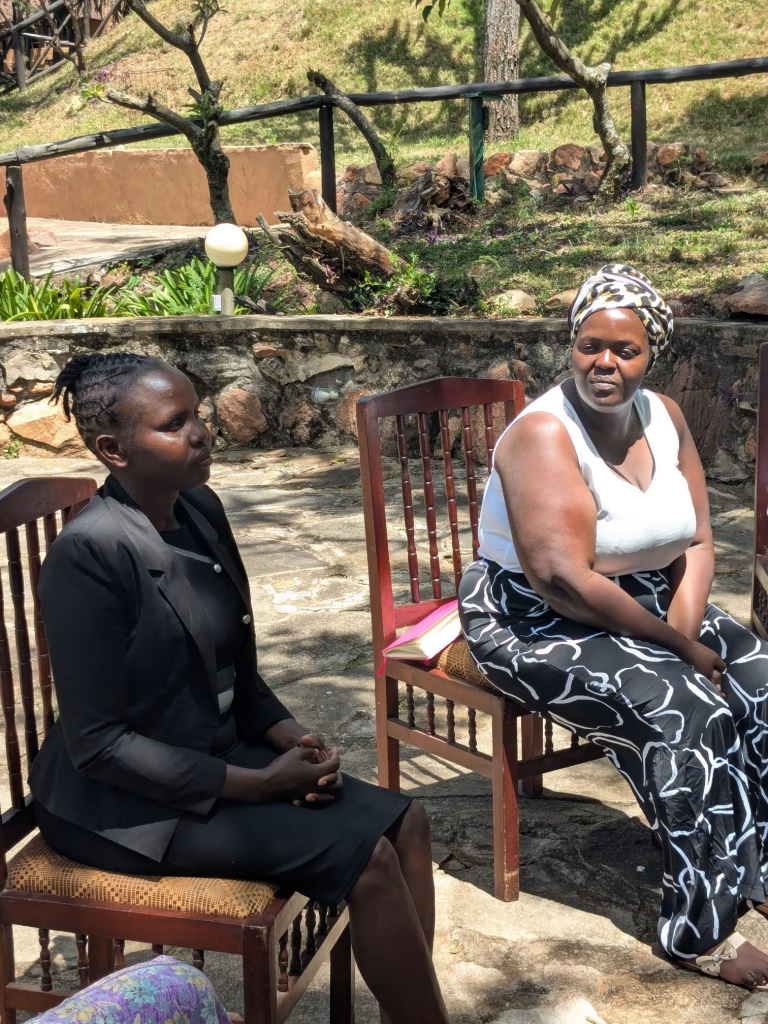
A new beginning at Olmekenyu
Within two weeks of receiving the donated point-of-care ultrasounds, Olmekenyu had already conducted 17 ultrasound scans:
- 17 women who did not need to travel 50 km to receive an ultrasound.
- 17 opportunities to identify potentially life-threatening complications early.
- 17 moments of care delivered with dignity and confidence.
For a facility that previously conducted zero scans, this is a profound shift.
“This is a new beginning for our mothers.” Anne, facility incharge, Olmekenyu health centre.
With point-of-care ultrasounds available, we now see:
- Fewer unnecessary referrals
- Women’s increased trust in the facility
- Early identification of risk
- Reduced out-of-pocket costs for families
- Improved continuity of care
This progress directly strengthens the three delays in maternal health model, especially delay three; ensuring that once women reach the facility, they receive timely and quality care.
Bridging systemic gaps through local capacity
Narok faces maternal health inequities rooted in access, geography and workforce shortages. But Anne’s story shows what is possible when frontline workers are equipped with tools designed for their context.
By introducing point-of-care ultasounds at Olmekenyu:
- Early detection of complications is expanded to frontline facilities in under-served areas.
- Skilled deliveries increase as women gain confidence in facility care
- Community Health Workers? can refer women knowing they will be attended to promptly
- For every scan, Kes 1,500 (£8.50) is saved for each family.
Anne’s commitment, combined with the right technology, is rewriting the maternal experience for rural mothers.
Partnerships at Child.org
At Child.org, we believe sustainable impact is built through collaboration. Our partnership with Hatch Technologies demonstrates how the right tools, placed in the hands of committed providers like Anne, can improve access, confidence and quality of care at the facility level. As we continue this work, we look forward to growing partnerships that strengthen maternal and neonatal health systems.
If you’re interested in partnering with Child.org, please contact us at hello@child.org.